| Product Documentation
HC Marketplace
Understanding Recurring Durations
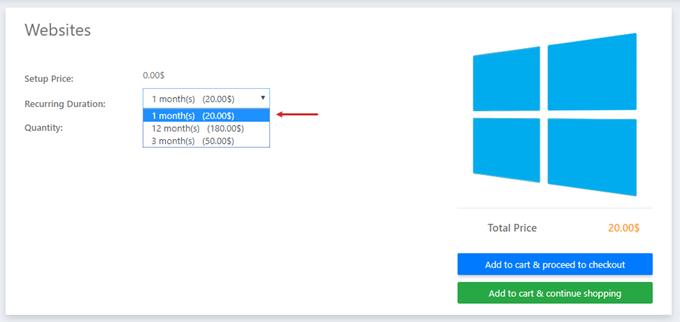
Providers often price the same package differently for different recurring durations. For instance they may price the same plan differently for Monthly, Quarterly and Yearly durations. Providers employ this as an upselling technique, inducing customers to pay a lower price for an annual plan while charging higher for its corresponding monthly.
It is important to understand why providers offer subscribers this choice. To understand this consider a provider selling a website plan with following durations:
| Monthly | Quarterly | Yearly |
| 5 websites | 5 websites | 5 websites |
| $ 20/Month | $ 50/Quarter | $ 180/Year |
Providers purposely tend to price a single plan with the same number of resources, differently in order to encourage customers to sign up to a larger duration plan. Higher plans allow them to collect more cash upfront while enabling them to invoice their customers less often and thus lowering their overhead.
They usually offer higher plans at a discount as seen in the example above. The same $20/Month plan is offered at $50/Quarter (17% discount) and $180/Year (25% discount).
Marketplace allows the handling of these recurring durations in its products section. Marketplace refers to these service plans as “Products”. After adding a product, Marketplace requires its recurring duration to be specified. It is at this point that more than one recurring durations can be specified.
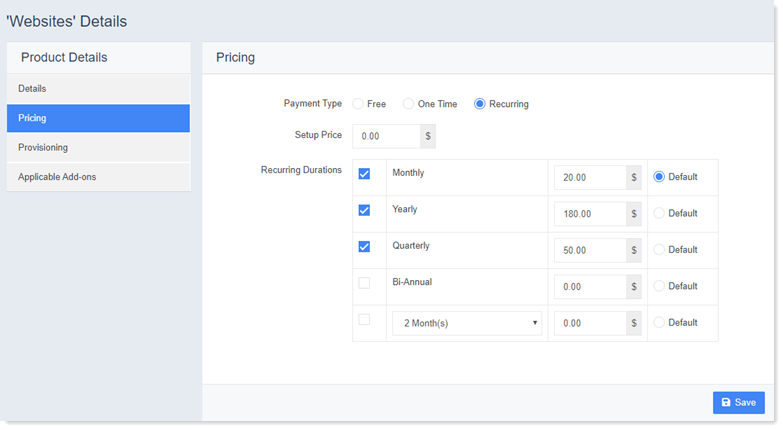
Any of these durations can be marked as default. Whenever a customer goes to subscribe the product, the default is shown first however a different duration may be selected and subscribed.