
| Product Documentation
Hybrid Control Panel (v10)
Understanding composite resources
Composite Resources (CR) are ready made price templates that can be sold to companies which require pre-defined price packages of fixed sizes. Composite Resources are ideally suited for companies selling hosted Exchange as they offer resources specific only to Exchange. Such providers can create and sell these CRs, with Exchange related resources to their customers. For instance, suppose a provider creates three CRs namely:
| CR1 | CR2 | CR3 | |
| Mailbox Size | 10 GB | 20 GB | 50 GB |
| Incoming Message Size | 15 MB | 25 MB | 35 MB |
| Outgoing Message Size | 15 MB | 25 MB | 35 MB |
| Issue Warning at | 9 GB | 18 GB | 48 GB |
| Maximum Recipients | 20 | 50 | 100 |
| Protocols | IMAP/OWA | IMAP/POP/OWA | IMAP/POP/MAPI/OWA |
Now the provider sells the following number of these CRs to one of its customers:
| Quantity | |
| CR1 | 15 |
| CR2 | 8 |
| CR3 | 5 |
These CRs can be included to a plan and sold to the customer.
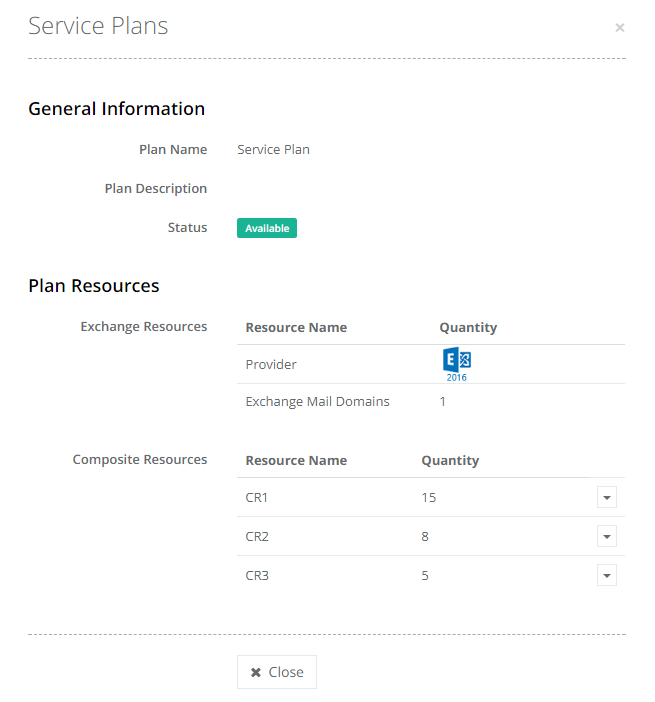
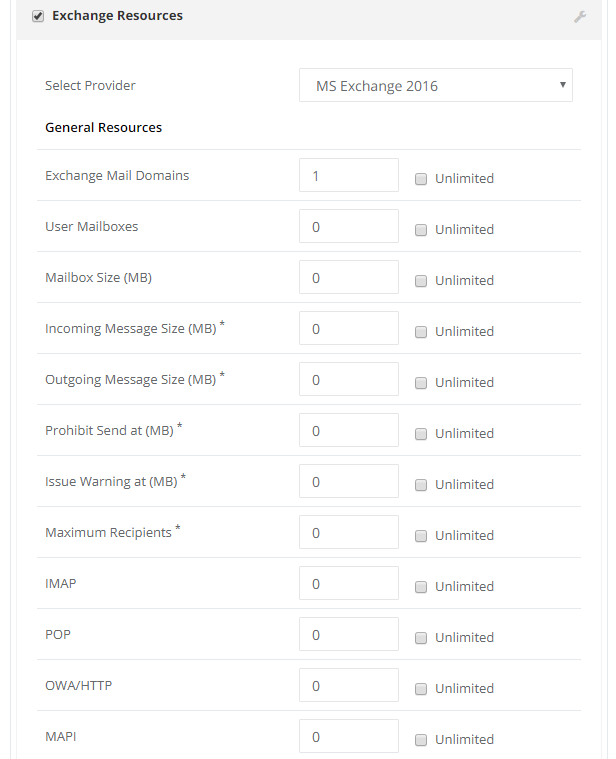
The Service Plan to which these CRs have been included, should itself host a zero number of these resources. It should only rely on the included CRs for provisioning.
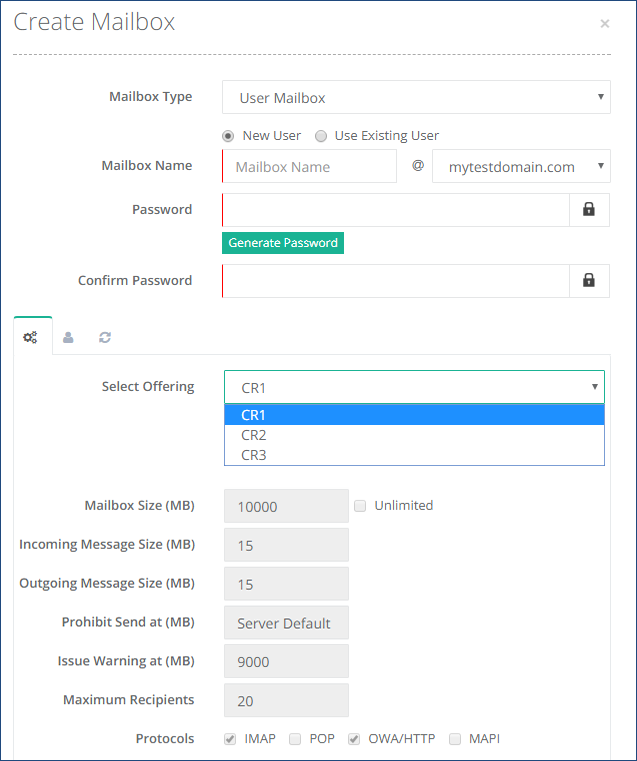
Now when the customer goes to provision an Exchange mailbox, he is presented with a choice to choose from any of the three CRs. Depending on the choice, a fix sized mailbox is provisioned and its resources are exclusive to it i.e. they cannot be shared with other mailboxes.
The biggest advantage of creating CRs is that different CRs can be assigned to different categories of employees in an organization. For instance, executives can be assigned larger mailboxes while small sized mailboxes can be secured for entry and lower level positions.